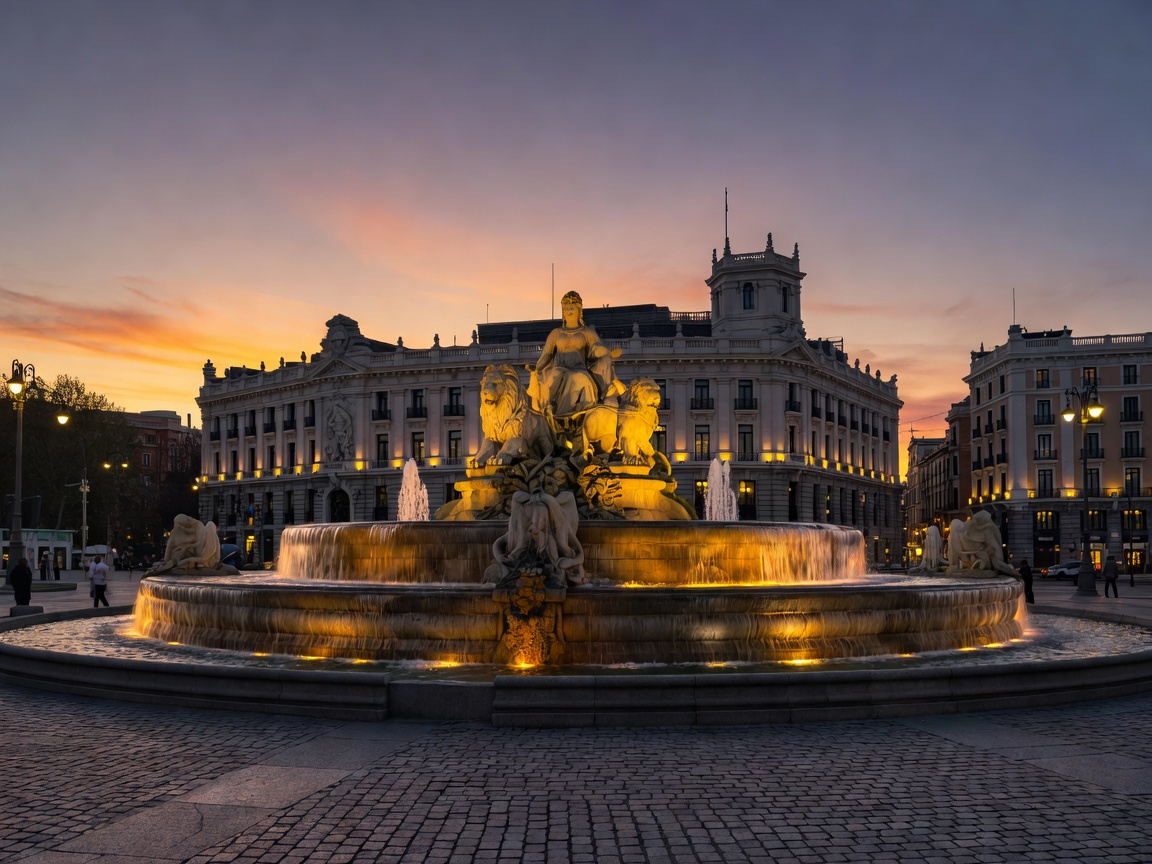
Plaza de Cibeles: The Altar of Madridista Celebrations
No football pilgrimage to Madrid is complete without standing before the 18th-century neoclassical fountain of the Phrygian goddess Cybele in her lion-drawn chariot, sculpted by Ventura Rodríguez. Though originally an urban water landmark, Cibeles was unofficially adopted as a sports celebration center in the 1980s by the famed Quinta del Buitre generation featuring Emilio Butragueño.
Whenever Real Madrid secures a major honor—whether La Liga or the Champions League—the team departs the Bernabéu atop an open-top bus toward Cibeles. There, under the glow of the majestic Palacio de Cibeles (Madrid City Hall), hundreds of thousands of fans convene while the club captain scales a dedicated gantry to place a club scarf and flag around the neck of the goddess. On a standard afternoon, visiting the plaza and ascending to the CentroCentro viewing terrace offers panoramic views over Paseo del Prado and Gran Vía.
Old Chamartín and the Ghost of Campo de O'Donnell
Before the stadium on the Castellana was constructed, Madrid played at several earlier grounds that trace the city's eastward expansion:
- Campo de O'Donnell (1912–1923): Located near the intersection of Calle de O'Donnell and Calle de Narváez, this was the club’s first enclosed pitch, where tickets were first sold at structured gates. Today, the area is a dignified residential neighborhood bordered by the Retiro park.
- Estadio de Chamartín (1924–1947): The direct predecessor to the Bernabéu, occupying virtually the exact parcel where the modern colosseum stands today, survived extensive wartime damage before Don Santiago Bernabéu spearheaded the ambitious construction of the new arena.
Ciudad Real Madrid at Valdebebas
Located near Adolfo Suárez Madrid-Barajas Airport, Ciudad Real Madrid in Valdebebas represents the club's modern technical heart. Covering an enormous 1.2 million square meters, it serves as the elite training facility for both the men's and women's first teams, alongside the world-renowned La Fábrica youth academy.
Within this compound sits the Estadio Alfredo Di Stéfano, a 6,000-seat boutique stadium named after the legendary Argentine-Spanish forward who transformed the club's trajectory in the 1950s. The reserve side (Real Madrid Castilla) plays regular league fixtures here. Attending a Castilla match is an affordable, intimate alternative to experience high-level football talent in a tranquil suburban sporting campus.
Historic Trail Stops in Madrid
| Trail Landmark | Historical Significance | Location / Metro | Visitor Highlights |
|---|---|---|---|
| Plaza de Cibeles | Official trophy coronation and fan celebration site | Banco de España (Line 2) | Fountain sculpture, Palacio de Cibeles observation roof |
| Puerta del Sol / Calle Alcalá | Site of early 1902 club meetings in historic cafes | Sol (Lines 1, 2, 3) | Vibrant city center, historical plaques, walking access |
| Estadio Alfredo Di Stéfano | Valdebebas training complex & academy match arena | Valdebebas (Cercanías C1) | Castilla fixtures, modern training architecture, bronze Di Stéfano statue |
The Royal Connection: From Madrid FC to Real Madrid
The royal patronage that granted the club its title in 1920 is inextricably tied to the Spanish monarchy. Supporters interested in this dynamic often incorporate a visit to the Royal Palace of Madrid (Palacio Real) in the city center.
Walking between the opulent halls of the royal residence and the modernist towers flanking Paseo de la Castellana underscores why Real Madrid has long been seen as an ambassador of Spanish sporting identity across the world.